Thursday, December 3, 2009

Theater Walk


Trafalgar Square

This walk took us through the theatrical district of London, including Covenant Garden, Leicester Square, Trafalgar Square, and Piccadilly Circus. I think the historical context of this area is very interesting. Especially it’s development into an entertainment district. In medieval times, this area was largely owned by the church. However, when Henry VIII broke away from the Catholic Church he confiscated all the property of the church. In Stuart times is when it really began to develop into an entertainment center. During this era Leicester Square developed a reputation as a scandalous entertainment center.


Somerset House

We began our walk at the Temple tube stop and walked along the Thames. One of my favorite things I saw on the walk was the Somerset House. I loved the architecture of the building and thought its history was fascinating. Elizabeth I lived here during her childhood. This was also the place that Oliver Cromwell was crowned by proxy.


Our entrance to “Theaterland” was marked by our entrance onto Drury Lane (home of the well-known muffin man). According to the book, two of the first recorded cases of the plague of 1665 were introduced here by French sailors. The book also said that at the end of the 19th century, Drury Lane was one of the worst slums in London. This is definitely a contrast to the area today.


Covent Gardens

Another one of my favorite parts of this walk was Covenant Garden. I really loved the atmosphere here. While we were there, a strings group was performing inside the covered market area. I was also excited to learn from the book that part of the beginning of the movie My Fair Lady was filmed here. We went into St. Paul’s church there and looked at the many plaques put up in honor of famous actors and actresses.


National Gallery in Trafalgar Square

Eventually we made our way to Trafalgar Square. Here we were able to see the National Gallery, the statue of Lord Nelson, and a view of Big Ben in the distance. It was fun to see the so many of the things that are so iconic in London.

The Country Walk

For our country walk, we took a train out to Kent and were lead on a walk by Bro Chiddick and two of his brothers. Kent is an area to the southeast of London, often referred to as “The Garden of England.” It received this title because of the many orchards and hop farms in the area.


Throughout our walk we used the many public footpaths found throughout England. These footpaths are available because legislation was passed that stated that if a farmer did not provide a footpath on his property, that people could just walk through his fields. On our walk we got to see a hop farm, part of what Kent is famous for. Hops are a small flowering plant that are used as a culinary stabilizer and flavoring. It is most often used in the brewing of beer. Bro Chiddick explained that during the summer holiday, many families would leave the city and spend the summer in the country. Often they would work on hop farms. This way they could make some money and they got housing for working on the farm.


The walk was really beautiful. Every time we leave London and go out into the country I am always amazed at how green and beautiful the country is. I love the rolling hills, the beautiful trees, and the old run down fences around the fields. When we went on the walk the colors were beginning to change to the beautiful reds and yellows of fall.


During our walk we saw an Anderson shelter. These were used during World War II during bombings. Rooms were dug into the ground and covered by a dome. People would retreat to these shelters during bombings. They didn’t actually protect from bombs, but they protected from shrapnel which was a huge danger. Bro. Chiddick told us a little bit about growing up during World War II.


During our walk it started to pour down rain. We got a taste of some real British weather! And we got to go on a little trail-blazing adventure. Bro. Chiddick took us a different way than they normally go and we ended up stomping through the woods in the rain. It was a lot of fun though and I know all the girls enjoyed it.


Posted by Picasa

Seats of Power Walk

The Seats of Power walk took us through the administrative center for London government and royalty. This part of the city really began to be developed during the reign of Henry VIII.

We began our walk along Victoria Embankment by the Thames. The first thing I saw when coming off the tube was Big Ben and the Houses of Parliament. And across the Thames I could see the London Eye. I learned that originally the London Eye was just built to celebrate the millennium, but it became so popular and iconic that they decided to keep it permanently.


As I walked along the Thames, I saw many war memorials that had been erected in memory of those who fought and died in World War II and other wars the British have been involved in. I particularly liked the memorial for the Battle of Britain. There were actually numerous war memorials throughout this entire walk. The British people obviously feel a great sense of honor and take pride in their military. I also think that London is especially sensitive to the effects of World War II because as a city it was so heavily targeted.

My two favorite parts of the walk were at the very end: St James Park and Buckingham Palace. When we came to St James Park we actually took a detour from the walk so that we could explore the park a little bit. I love that there are such nice parks in the city. It gives people a chance to escape the hustle and bustle that comes with living in one of the world’s major cities. We finally made it to Buckingham Palace. That was exciting because it is something so iconic. Buckingham Palace was built for the Duke of Buckingham in 1703. It was purchased by George III in 1702, but Victoria was the first monarch to live here on a permanent basis. Now, the palace is the official London residence of the Queen.

I really enjoyed this walk. I was able to see some of the major tourist sites of London, as well as the administrative center of the city. I was also able to learn a lot about the places and buildings I was seeing, which made them mean a lot more to me.

Monday, November 30, 2009

Herefordshire


Benbow Farm

Herefordshire was first introduced to the gospel during the first mission to Britain. Wilford Woodruff was sent to preach in the area known as the Potteries. He served there for 6 weeks, following which William Benbow took him to Herefordshire and introduced him to his brother, John Benbow. John was a member of the United Brethren. John and his wife Jane played an important role in the spread of the gospel in Herefordshire.


The pond where Wilford Woodruff baptized hundreds of converts

The Benbows owned a farm in Herefordshire called Hill Farm. It was in a pond on their land that Wilford Woodruff baptized hundreds of people, including all but one member of the congregation of the United Brethren. It was neat to be in the place where so many people were baptized. We also learned about the Benbow’s generosity. Not only did they allow Wilford Woodruff to use their land, but Jane Benbow, along with Anne Kington, helped finance the printing of the Book of Mormon. The Benbows also used the money they earned from selling their farm to pay for 40-50 saints to immigrate to the United States. I personally learned a lot from the example of the Benbows. They had means and they used those means to help others. Although I may not be in a position to give financially, I can give of my time and talents.


Herefordshire Beacon

Probably one of my favorite parts of the trip was going to Herefordshire Beacon. This was the place where Wilford Woodruff would go to find peace and escape the constant needs of the people. During the second apostolic mission Brigham Young, Wilford Woodruff, and Willard Richards held a historic meeting here. At this meeting they decided that Brigham Young should return to the North to publish the Book of Mormon. After being up there I can understand why Wilford Woodruff came up there for peace. It is such a beautiful place to be and to overlook the beauty of our Heavenly Father’s creations.


View from Herefordshire Beacon at sunset


Gadfield Elm Chapel

We finished our trip by stopping by the Gadfield Elm Chapel. This is the oldest, longest standing meeting house. Originally, the chapel belonged to the United Brethren. It was given to the Church after the entire congregation converted. The Church sold it to raise money for the poor. Finally, in 1994 the land and the church building were put up for auction. The local members raised 10,000 pounds to buy the building. The faithfulness of the members in raising the money to buy the chapel is such an example to me.


Monday, October 26, 2009

Westminster Abbey


Westminster Abbey dates back to around 960 AD. However, the church that stands there now is from the 13th century. Westminster is the traditional coronation place of coronation of British monarchs. 38 monarchs have been crowned in the Abbey. It is also the burial and memorial place of monarchs, poets, politicians, etc.


King Henry III built the Abbey as we know it today. He spend 17 million pounds on the construction of the Abbey.


There are multiple monarchs buried in the Abbey. Henry VII and Elizabeth of York are buried in chapel of Henry VII. Their tomb cost 1/2 million pounds. Elizabeth I and Mary I, also known as Bloody Mary, were also buried in the Abbey. Mary is buried below Elizabeth. Their epitaph says that they share a tomb as they shared a throne, and that they are one in their hope of resurrection.


I also got to see the coronation chair that has been used at every coronation since it was made by Edward I around 1300. The chair was designed to hold the Stone of Scone. This was a stone taken from the Scots. It has since been returned to Scotland but it is returned to England for every coronation. Unfortunately we couldn't take pictures in the Abbey so I don't have any pictures from the inside.

Some of the famous people buried or commemorated at Westminster Abbey include:
  • Geoffrey Chaucer
  • Jane Austen
  • TS Eliot
  • Charles Dickens
  • Issac Newton
  • Charles Darwin
  • William Wilberforce
I also saw the Grave of the Unknown Solider. The grave stone read: "They buried him among kings because he had done good toward God and towards his house."

I really enjoyed going to Westminster Abbey and seeing the graves and memorials of so many influential people.

Preston

Preston

September 24, 2009

Preston was one of the first places in England where the gospel was preached. It was chosen because Joseph Fielding had family there. When we arrived in Preston we went to the center of the town and we saw the obelisk where the missionaries, such as Orson Hyde, preached. Preston also was the first area Gordon B. Hinckley served in during his mission.

When the missionaries were serving in Preston in the late 1830s it was during the Industrial Revolution. This led to urbanization and when the missionaries arrived they said that they had never seen such a difference between the rich and the poor. This was part of the reason there was a lot of strife and strike during the period. Karl Marx said that Preston would be England’s St. Petersburg, a place of revolution.


We were also able to see the house on St. Wilfred Street where the missionaries stayed. This was also the place where the missionaries saw the vision of evil spirits. When Joseph Smith heard about this incident he was glad because he said it meant something good was going to happen.


The Ribble River runs through Preston. This was where the first converts in England were baptized. The first saint to be baptized was George Watt, who won the footrace to get to the water first. It is estimated that between 7,000 and 9,000 people came to witness these baptisms. They referred to them as “dippers” because the baptized by immersion. Watt knew shorthand and when he emigrated to the United States he recorded for Brigham Young and eventually put together the Journal of Discourses.


We also went to a couple little towns outside of Preston, including Ribchester and Downham. Heber C. Kimball said that an ancient apostle stood on one of the hilltops in Downham.


We ended our time in Preston at the Preston temple, which is actually located in Chorley, outside of Preston. We had the opportunity to walk around the grounds. I’m sure the saints who lived and were converted in Preston during the 19th century would be proud to see the temple that now stands there.


Southall


Southall London

September 11, 2009


Sikh Gurdwara

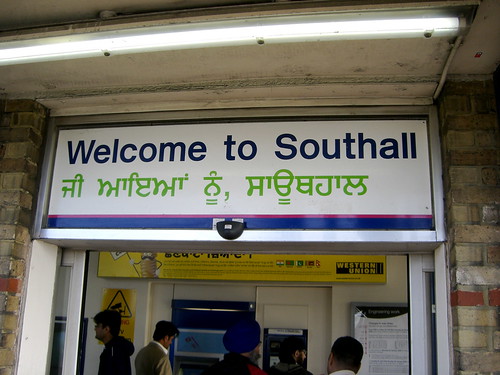
Our first stop in Southall was the Sikh temple, known as a Gurdwara. We had the opportunity to go into the prayer hall and observe the worshippers there. The one thing I noticed was the obvious respect and reverence of the people worshipping there. I even saw a little boy, who was probably no more than three, touch his head to the ground as a sign of respect like his parents. Another example of the Sikh’s reverence is how they treat their sacred book. They wave a chaur sahib over the book to show respect and keep the air around it clean. I noticed that both men and women do this. This connects to what we discussed in class about how Sikhs believe that men and women are equal. The man who spoke to us about Sikhism explained that they believe men and women are equal because our spirits are genderless. I found that really interesting especially when you compare it to our LDS belief that gender is crucial to our role.

I really enjoyed learning more about Sikhism. The word Sikh means student, learner, or disciple. Members of Sikhism view it as a way of life, similar to how we believe the gospel is a way of life. They also believe that we must change ourselves to fit God, not the other way around. Sikh’s are also very accepting and open of other religions. They believe that God is everywhere and resides in everyone. Regardless of your faith, they believe you should be the best you can be in your faith and have the closest relationship with God possible.

Following the Sikh temple we went to two Hindu temples. Hindus believe in many gods and their temples are filled with statues of these gods. The Hindu temples were quite different from the Sikh temple. The Hindu temples were much more elaborately decorated, with lights, bright colors, icons, and rich fabrics. This is also very different from our places of worship. However, as I sat and watched the people I realized that although they worship in very different ways than I do, they are still showing respect and reverence in the best way they know how. The people I saw took their time in front of each of the gods they wished to worship and showed their reverence. Many people brought offerings of money or of food to place in front of the icons of the gods.

Even though these two religions don’t hold all of the same beliefs as our religion and they worship in a different way, I can still feel their reverence and how much they love their faith.


Front of Sikh Gurdwara